
Our responses to some of the most common questions and concerns raised when we recommend traffic management in Harborne East.
- Who are you?
- Why are you trying to change the roads in Harborne East?
- Who makes decisions about this scheme?
- Why haven’t I been consulted?
- Why don’t you focus on enabling traffic flow to reduce traffic?
- Why don’t you tackle parking?
- Are you working with the schools to tackle people driving their children to and from school, including those out of the catchment area?
- Making people drive further/slower/faster means more pollution, doesn’t that undermine your plan?
- If this plan goes ahead, I won’t be able to do everything as I do it now
- Have you considered impacts to businesses?
- The road is for cars
- How can I support you?
Who are you?
Better Streets for Harborne & Quinton are a community group that campaigns for changes to our travel and planning infrastructure to improve the safety, efficiency and sustainability of our streets. We live, work and shop locally. Our kids use the local schools. We want to see the roads we use become safer, healthier and fairer public spaces.
Why are you trying to change the roads in Harborne East?
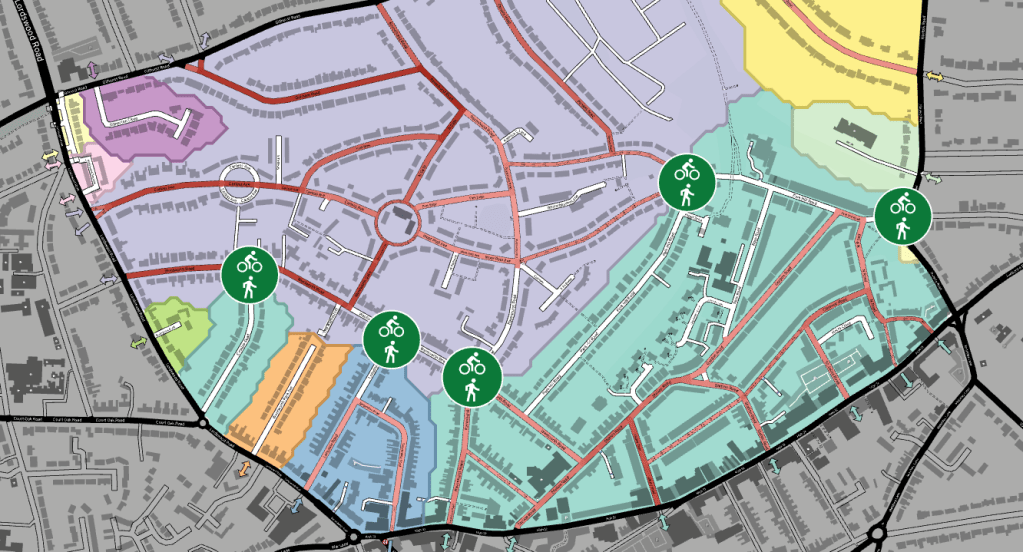
Traffic is extremely high in Harborne East. This is the area North of the High Street and including Harborne Primary School and Chad Vale Primary. Much of the traffic is cutting-through to avoid the main roads. We’re proposing a scheme to reduce traffic that will improve road safety and air quality.
You can read more about our reasoning on this page https://betterstreetshq.com/2024/11/15/why-are-we-proposing-a-harborne-east-traffic-management-scheme/
Who makes decisions about this scheme?
The recently created Environment and Transport Neighbourhood Fund (ETNF) suggests engagement with local community groups to identify local issues and help develop schemes.
Schemes must make a positive contribution in the following areas:
- Road Harm Reduction (a specific priority for this funding)
- Use of Active Modes of Travel (i.e. walking, wheeling & cycling)
- Air Quality, carbon reduction, and climate change mitigation
Anyone is welcome to engage their councillors with ideas to meet these aims. We have discussed our recommended plan with the local councillors, including at a public ward forum meeting in November 2024. It will be further reviewed at another public ward forum likely taking place in January 2025.
Once a scheme is chosen, the request for the funding is put forward by the local councillors.
Officers at Birmingham City Council will review all plans to ensure they are achievable and will meet the aims and objectives of the funding.
Why haven’t I been consulted?
We’re a community group trying to help identify problems and solutions in our local area. If a scheme receives support from local councillors, city planning and highways engineers, and is ultimately approved for funding, consultation is carried out by the council.
We wanted to gauge support levels from the community before proposing our scheme to the council. This meant a small group of volunteers going out and speaking to a (statistically significant) representative sample of households in the area between October and November this year. We collated residents’ views and experiences of traffic in the area, and included these in our initial presentation of plans which we presented at both a Better Streets meeting, where we invited everyone we surveyed, and again at the councillor-led ward forum in November 2024.
We believe in being open, which is why we publish outcomes and ideas on our website. But at this point, we are only pitching ideas to the council. If a scheme is taken forward, it will be subject to the council’s processes and legal requirements.
Why don’t you focus on enabling traffic flow to reduce traffic?
Choice of transport mode isn’t constant, like the flow of water. As thinking humans, we make a choice when we’re about to make a journey. How far is the destination? What’s the parking like? What time is it? If we see a route or mode as faster and easier than another, we will choose that. If we make a route faster, we don’t remove the traffic that is on that route, we make more popular. In transport planning, this is called “induced demand”. Soon, you’re back to square one, but with even more and faster traffic.
The opposite is also true. If a journey is seen as too difficult by a car, say a short drive to Waitrose is now a trip around the boundary roads, then people often just choose another way. This makes concerns about displacement a tricky topic, as research typically shows that LTNs or even road narrowing schemes don’t create additional traffic. In transport planning, this is called “traffic evaporation”. It’s not guaranteed as there are so many factors at play, but it’s a counterintuitive outcome that is more common than people think.
Why don’t you tackle parking?
Harborne faces many traffic challenges, and we’re very conscious that parking is one of them. We’ve recently discovered a small (almost anything to do with roads is staggeringly expensive) pot of money and we’ve tried to put together a plan that will make the biggest impact on traffic problems within a very limited budget. It’s limited in scope, and it’s only a small part of a bigger picture for the wider city, but it’s a step to support and strengthen the local community. Unfortunately, given the very limited size of the fund, a parking solution is not an option right now. But it’s certainly something the community could consider in future, if there’s popular support and money to enable it.
Are you working with the schools to tackle people driving their children to and from school, including those out of the catchment area?
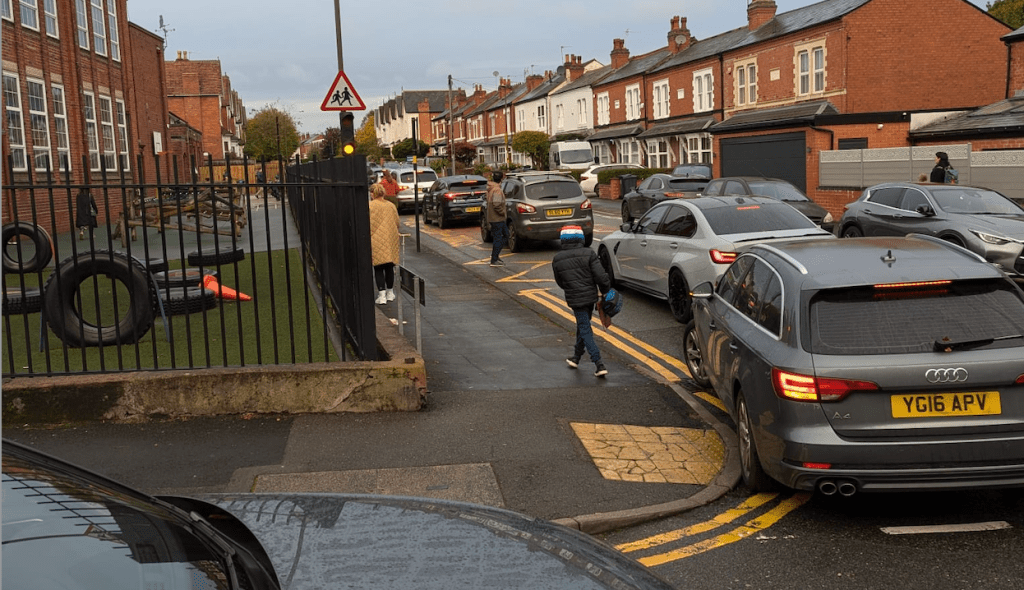
We’ve talked to both schools in the area (Harborne Primary and Chad Vale) and they are supportive of plans to make the streets around the schools safer. We believe the plans will result in more children walking and wheeling to school and fewer cars driving and parking dangerously, endangering pupils.
We’re hugely privileged in Harborne to have a large number of really popular schools. But policing the catchment areas is a job for the council and the schools, not a volunteer organisation. The funds available right now have to be spent on the road network itself, which is why this plan has the focus it does.
Making people drive further/slower/faster means more pollution, doesn’t that undermine your plan?
Air quality is a huge challenge for Birmingham; we have much worse air quality than London and even Manchester. This plan for these few streets of Harborne East is not going to make much of a difference to that background level. However, we hope that by reducing the traffic cutting through – much of which travels on roads that wrap around the primary schools in the area – some of these little lungs will breathe in slightly cleaner air while they’re being dropped off, picked up, or outside at playtime. When it comes to lung health and physical distance from air pollution, metres matter. Air quality is only one piece of the puzzle, and reduced cut-through traffic stands to benefit the kids (and everyone else) in much more visible ways, too, as they navigate the residential streets carrying less of the fast, high-volume traffic that we’re used to today.
If this plan goes ahead, I won’t be able to do everything as I do it now
To be honest, it’s not always that easy doing what we do now; just ask the locals trying to drop kids off at the schools in the morning or the residents of Park Hill Road, Station Road, or Margaret Grove trying to leave their homes by car when the road is full of queuing cut-through traffic. Solving that is a huge problem, and big change is slow. Birmingham is one of the most car-dependent cities in the country, and that’s not going to change overnight. It’s going to take much more than one neighbourhood reimagining a few streets! But we hope that with this trial (12-18 months) we can all get a small taste for whether the proposed changes take our community a step in the right direction. If the trial doesn’t work, it can all be undone.
Have you considered impacts to businesses?
As people who live and shop in the area, damaging business is the last thing we want to do. We feel confident that a scheme which discourage motor traffic won’t damage most businesses, as evidence shows that walkable neighbourhoods mean thriving retailers. At the moment, many people drive out to Selly Oak. We’re hoping that this nudge will encourage more people to choose to shop locally and invest in their own community.
The road is for cars
The road is for everyone: cars, buses, bikes, wheelchair-users, pedestrians, and everyone else. Some roads, though, were intended to service the estate and weren’t conceived to handle the sheer volume and speeds of traffic that they now experience, particularly from traffic using the (often narrow) residential roads as a shortcut to avoid the (often emptier) ‘arterial roads’. We can all think of pinch-points, whether it’s the standstill morning traffic queuing up Margaret Grove, the drop-off and pick-up parking chaos at the junction of Park Hill Road and Nursery Road, or the racers flying along Wentworth and Ravenhurst. The plans we’ve proposed aren’t intended to stop people using cars, just to try and tackle the ever-increasing volume of cut-through traffic.
How can I support you?
A simple act is to write to our local councillors to express your support for our proposals.
If you’d like to help further, we’re planning a campaign to count traffic across the area. If the scheme goes ahead, we want there to be robust evidence to show its success or to measure its failures.
We’re also keen to hear your thoughts on this, or any other area of Harborne or Quinton you feel needs help in tackling transport inequality.
Our email is betterstreetshq@gmail.com or you can use the comments page on this site.
Thank you



 Better Streets for Harborne & Quinton